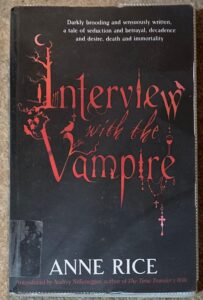
… probably decades after I should have come to it: teenage me would have loved it! Me now, I grew to love it. What it has to say to me – about loss, about creativity – is not necessarily what I whould have taken from it then. Although, of course, like most teenagers, I understood perfectly the essential impossibility of perfect communication with another human being.
What also struck me now, however, was just how many words it used. The descriptions, the philosophising, Louis’s compulsive pendulum-swings beetween self-flagellation and self-justification – tedious, at times, as all compulsions are – there were paragraphs, pages even, which I suspect an editor would cut these days. Or, to be more precise, I would cut. As I read, I found myself mentally annotating the text with all the strictures I’ve come up against myself. Show, don’t tell. Do we need this much detail? Guilt already dealt with in chapter 3. Etc.
To some extent, I think the repetition of, the continual elaboration on, the book’s central themes is necessary to re-inforce Louis’s own closed-loop ruminations, as I suggested earlier. But also, not necessary. You could have hit the plot points without the padding. Yet that ‘padding’, that lingering sensuality of the prose, is also part of the gothic sensibility into which Rice inscribed herself. What is it we lose when we read – and write – with one eye always on the Netflix adaptation?
As a writer, it bothered me that I was initially put off by too many words. Have I grown more stupid over the years? (probably) Have we all been neurologically re-wired to follow stories in a completely different way from how we did just a few generations back? (possibly) And if so, does that mean we’re culturally severed from the artistic output of previous centuries? (if Anne Rice feels dated, what chance do Samuel Richardson and Aphra Behn stand?)
A question I kept asking myself was, would Interview With the Vampire be published today? I suspect most writers ask that question about older books they enjoy. It’s not that publication itself is some Holy Grail we’re all after. It’s more that, on some level, we all write to be read. To communicate something. And if the form in which we communicate it puts anyone off from reading it, how will it ever get through?
But what if what we want to communicate needs – demands – a different form?
Louis’s isolation, after all, is not just confined to vampires.