www.remcauliffe.com

Curious writer

Menu
  • Welcome to my world…
  • Author bio
  • Bibliography
  • Privacy Policy
Menu

Month: March 2026

Names are powerful.

Posted on 29 March 2026 by Brinded_Cow
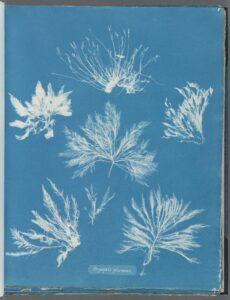
A cyanotype - white impression on a cyan background - of various pieces of seaweed.
Cyanotype of photograph by Anna Atkins.
Spencer Collection, The New York Public Library. “Bryopsis plumosa” The New York Public Library Digital Collections. https://digitalcollections.nypl.org/items/202e5750-073a-0135-858a-015d1fdefa4a

That’s what I wrote in the preface to Elderwood, where characters move between different versions of their names – nicknames, translations, anglicisations – as their identities slip between the different roles they play.

It’s also something I’m aware of in my own life. I publish my fiction under a pseudonym. It’s a practice which divides a lot of people. For me, I have a day job where I’m expected to communicate facts. So keeping a clean separation between my professional life and my writing life gives me the freedom to create fiction.

Added to which, I’m a very private person.

But writing Elderwood, and in particular, writing that preface, makes me think again about my choice of pseudonym.

I chose the surname ‘McAuliffe’ because it sounds a lot like my mother’s maiden name – to the point where someone transcribed her name as that on my baptismal certificate (yes, there is such a thing as a baptismal certificate! and I have one!). A kind of Ellis Island confusion, I guess. At any rate, when I was growing up, I always thought that if McAuliffe was actually my name, I’d fit in so much better. So when the time came, it seemed like a natural choice in my quest for anonymity through pseudonymity.

Fitting in, of course, depends on where you find yourself.

Now that I no longer live in Ireland, ‘McAuliffe’ doesn’t have the same ability to blend into the background. Instead, it suggest an origin which arguably isn’t mine. Although I am Irish by birth, by education, by osmosis and by allegiance, my parents weren’t, and I was born long enough ago to remember a time when this was enough to make me stand out. (They weren’t English, either, which let me off one hook – the colonial legacy – and straight onto another: unfamiliarity…)

This could be why the hauntings in Elderwood are so entwined in how national identities shift and reshape themselves. In the story, it’s very much about how Anglo-Irishness has been constructed – and othered – in Ireland. But I can see now that part of what I was working through was the difficulty of straddling cultures, and of feeling that you don’t quite belong in the only homeland you know.

I’m happy to say that Ireland’s changed a lot since I was a child. From the outside, at least, it seems to be far more accepted that one can be Irish without having a surname that translates as Gaeilge, or a generational history rooted in one location, or a particular creed or colour. I’d like to believe that this is how things look from inside as well, and I’m looking forward to hearing new Irish voices expressing their reality. Which isn’t to denigrate the weight and value that cultural rootedness also holds. But like any other identity, surely Irishness can only become richer by becoming more plural.

And as for finding a surname that blends into the background: the great thing about living in London is that the background is so variegated that nothing blends in, and yet everything does. For now, at least, I’m keeping ‘McAuliffe’. It’s a name I have history with.
Just read: ‘Old Soul’ by Susan Barker

Posted on 29 March 202629 March 2026 by Brinded_Cow
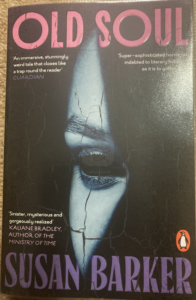
Cover of 'Old Soul' by susan Barker, showing an image of a sliver of a face - a single eye - peering out from a lack background. The face has the eyebrows and eyelashes of a human, but the empty eye socket of a doll, and the cracked surface of a statue. Copy of this book gratefully borrowed from Waltham Forest Libraries.

‘Lapidary’ is the word that occurs to me when I think of this book. Not just because of its running motifs of sculptors and statues, but because the prose itself glitters with that polished, incisive quality I associate with the faceting of fine gemstones. In the afterword, Barker writes about writing the book over a period of years, and every perfectly crafted sentence rings with the evidence of such dedication.

It’s also a genuinely terrifying read, making great use of two atavistic horror tropes: the immortal being which survives by preying on humans, and the power of a likeness (be it drawing, reflection or photograph) to steal someone’s soul. Although that isn’t quite what happens here, the uncanniness of portraits – and the combination of receptiveness and invasiveness that goes into their making – is fully realised throughout the narrative. As perspectives and time periods shift and interweave, we are left with the disquieting sense that each storyline was out of kilter long before the intrusion of the narrative’s ‘evil spirit’.

First novel fears

Posted on 8 March 2026 by Brinded_Cow
My first novel is going to be published.
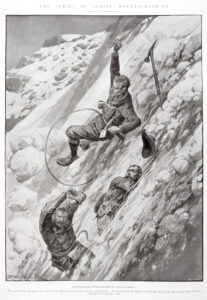
An early twentieth-century engraving of three male mountain-climbers losing their purchase in an avalanche and sliding down the mountainside.
‘Mountaineers overwhelmed by an avalanche’, by R Caton Woodville, from The Illustrated London News 4 October 1910. From the British Library archive

I still can’t get used to writing that. It doesn’t seem entirely real, and I can’t quite believe that this thing I’ve written, this long splurge of text I’ve spent so long agonising over and chopping and changing can actually be called a novel.

First up, I never thought I could write anything longer than 10,000 words. After spending mot of my life writing short stories, reading short stories, dreaming short stories, something flipped in my brain and I felt the need to inhabit something longer. I began to lose myself in long novels, in multi-season TV dramas. Maybe it was an attention re-set: like many people, I’ve had long periods of shredded concentration. Forget writing a novel, even reading one was beyond me: so flabby, all those words … the truth is, my shattered sense of reality just couldn’t follow a longer narrative arc.
And then life changed – I changed – and suddenly I wanted things to grow.

My mind teemed with new stories, all of which required juggling multiple characters and storylines, and I had absolutely no idea of how to go about it.

So I decided to start small. Try my hand at writing a fairly straightforward story in a structure I knew and loved: the haunted house. I just have to see those words on a book’s cover, and I’m heading over to the till or check-out desk, excited to get home and plunge into a new discovery. Over the years I’ve read so many brilliant variations on the theme, that it’s also quite a daunting sub-genre to take on. But I was under no illusions: I would not be writing a brilliant novel here, just using the template to learn how to (eventually) write one.

That was my first mistake.

So, I devoured all the information I could find on narrative structure: inciting incidents, plot points, character arcs, etc. I made charts and spreadsheets, figured out exactly where to pin a story on it, and wrote. Kind of like painting by numbers, I told myself, but something just didn’t feel right.
Coincidentally, something amazing happened: I entered the opening chapter of my first draft into Pen to Print’s Book Challenge, and it was accepted. Meaning I had won a year’s mentoring and a guarantee of publication by New Generation Publishing at the end of it. I couldn’t believe my luck (still can’t, if truth be told – impostor syndrome runs deep in me).

Of course, all it took was one external reader – my mentor – to look at this zero draft I’d slogged so hard over, and the whole house of cards fell apart.

I hadn’t really done any of the important work I hadn’t thought about why the characters were doing what they did, or what they wanted. They were all simply puppets in service of a plot. Which, if it had been a better plot, I might have got away with (I’ve read and watched some great sci fi stories without caring too much about the minimal characterisation). But my plot was not only weak, it was completely artificial. I’d borrowed some basic genre tropes but not bothered to invest them with a sense of life.

By now, of course, I was under this commitment to deliver a finished manuscript by the end of the year. And I couldn’t bring myself to hand this one in. So I did what any self-respecting eejit would do at this stage. With over half the year over, I rolled up my sleeves and decided to start all over again.

And I mean, all over again. So, the original school setting – gone. The main character’s connection with the house – totally different. Hell, it wasn’t even set in the same country! Because suddenly I realised that the haunting I was trying to write about wasn’t a generic haunting at all; it was a specific haunting, and it didn’t belong to the English countryside.

And so Elderwood had a second birth, and emerged as something else.

The result was something I certainly felt happier with, something that had begun to mean something to me.

In an ideal world, I’d have tucked my finished re-draft away for a few months and revisited it again, preferably with my mentor or some other advisor on board, to remould and polish it into something closer to what I wanted this novel to say. But this isn’t an ideal world, and by then I’d burned my way through my twelve months’ grace period and had to submit it as it was.

There’s a large part of me that mourns the novel it could have been. Putting it out in the world in its current state is perhaps throwing away the chance I had to fulfil its promise. Instead, I’m exposing its flaws, inviting criticism of all the shortcomings I’m aware of, and many that I haven’t yet had time to recognise.

I have to accept that this, too, is part of the learning process. Just as I couldn’t put my finger on what was wrong with that very first draft until my mentor saw it, I can’t identify what needs to improve without this level of exposure. It stings. But I want the next novel to be better.

Recent Posts

  • Names are powerful.
  • Just read: ‘Old Soul’ by Susan Barker
  • First novel fears
  • Just finished reading ‘Interview With the Vampire’

Recent Comments

No comments to show.

Archives

  • March 2026
  • February 2026

Categories

  • Reading
  • Uncategorised
  • Writing
© 2026 www.remcauliffe.com | Powered by Minimalist Blog WordPress Theme